
Welcome! I am currently a Ph.D. student at RaHAIC Group, Nankai University, advised by Prof. Xuebo Zhang and Dr. Shiyong Zhang.
My research interests include Autonomous Exploration, Multi-robot System, Trajectory Planning, and Mapping. You can check my open-source code on Github for detailed information.
I will graduate in Jul. 2027. I plan to do postdoctoral research after graduation. So, if you would like to offer me an opportunity, please let me know, I really appreciate it!
Warning
Problem: The current name of your GitHub Pages repository ("Solution: Please consider renaming the repository to "
http://".
However, if the current repository name is intended, you can ignore this message by removing "{% include widgets/debug_repo_name.html %}" in index.html.
Action required
Problem: The current root path of this site is "baseurl ("_config.yml.
Solution: Please set the
baseurl in _config.yml to "Education
-
 Nankai UniversityCollege of Artificial Intelligence
Ph.D. StudentSep. 2022 - present -
 Northeastern UniversityThe Faculty of Robot Science and Engineering
B.S. in RoboticsSep. 2018 - Jul. 2022
Honors & Awards
-
National First Prize in the Baidu Deep Learning Creative Group of the 15th National Intelligent Vehicle Competition2020
-
China Robot Competition FIRA Small Group - Simulation Group National First Prize2020
Selected Publications (view all )
.gif)
RIPNEON: Memory-Lite and Computation-Efficient Occupancy Mapping via Block Read-Write and Key Grids Expansion
Qianli Dong, Xuebo Zhang, Shiyong Zhang, Haobo Xi, Ziyu Wang, Zhe Ma, Haobo Xi, Zhiyong Zhang
IEEE Conference on Robotics and Automation (ICRA)Accepted. 2026
In this work, we propose a memory-lite and computation-efficient occupancy mapping algorithm for LiDAR-based robotic exploration plan- ning. To accelerate the query operation and reduce the memory usage, we adopt the grid-block as the basic data structure and propose to dynamically read and write blocks around the sensor. For each block, the occupied grids and frontier grids are maintained in two separate lists, serving as key grids for the map update. Instead of updating free grids by ray-racasting, we propose a key grids expansion algorithm to avoid repetitively querying grids on casted beams. The proposed algorithm not only speeds up the occupancy map update but also detects the frontier grids, which are crucial for exploration tasks, without extra computation. We compare the proposed method with state-of-the-art mapping methods on the KITTI dataset and a self-collected dataset.
RIPNEON: Memory-Lite and Computation-Efficient Occupancy Mapping via Block Read-Write and Key Grids Expansion
Qianli Dong, Xuebo Zhang, Shiyong Zhang, Haobo Xi, Ziyu Wang, Zhe Ma, Haobo Xi, Zhiyong Zhang
IEEE Conference on Robotics and Automation (ICRA)Accepted. 2026
In this work, we propose a memory-lite and computation-efficient occupancy mapping algorithm for LiDAR-based robotic exploration plan- ning. To accelerate the query operation and reduce the memory usage, we adopt the grid-block as the basic data structure and propose to dynamically read and write blocks around the sensor. For each block, the occupied grids and frontier grids are maintained in two separate lists, serving as key grids for the map update. Instead of updating free grids by ray-racasting, we propose a key grids expansion algorithm to avoid repetitively querying grids on casted beams. The proposed algorithm not only speeds up the occupancy map update but also detects the frontier grids, which are crucial for exploration tasks, without extra computation. We compare the proposed method with state-of-the-art mapping methods on the KITTI dataset and a self-collected dataset.
.gif)
Fast Exploration Planning with Learning-Based Motion Time Prediction for Aerial Robots
Ziyu Wang*, Qianli Dong*, Xuebo Zhang, Shiyong Zhang, Haobo Xi, Zhe Ma, Mingxing Yuan (* equal contribution)
IEEE Conference on Robotics and Automation (ICRA)Accepted. 2026
In this article, we propose an efficient dual-layer exploration planning method. The insight of our dual-layer planning method is efficiently finding an acceptable long-term region routing and greedily exploring the target in the first region of routing at high speed. Specifically, we propose a long-term region routing approximate algorithm, called “exploration-oriented heuristic double-tree algorithm”, to ensure real-time planning in large-scale environments. Then, the viewpoint in the first routing region with the highest curvature-penalized score, which can effectively reduce decelerations caused by sharp turn motions, will be chosen as the next exploration target. To further speed up the exploration, we propose an aggressive and safe exploration-oriented trajectory planning approach to enhance exploration continuity and speed. The proposed method is compared with state-of-the-art methods in challenging simulation environments.
Fast Exploration Planning with Learning-Based Motion Time Prediction for Aerial Robots
Ziyu Wang*, Qianli Dong*, Xuebo Zhang, Shiyong Zhang, Haobo Xi, Zhe Ma, Mingxing Yuan (* equal contribution)
IEEE Conference on Robotics and Automation (ICRA)Accepted. 2026
In this article, we propose an efficient dual-layer exploration planning method. The insight of our dual-layer planning method is efficiently finding an acceptable long-term region routing and greedily exploring the target in the first region of routing at high speed. Specifically, we propose a long-term region routing approximate algorithm, called “exploration-oriented heuristic double-tree algorithm”, to ensure real-time planning in large-scale environments. Then, the viewpoint in the first routing region with the highest curvature-penalized score, which can effectively reduce decelerations caused by sharp turn motions, will be chosen as the next exploration target. To further speed up the exploration, we propose an aggressive and safe exploration-oriented trajectory planning approach to enhance exploration continuity and speed. The proposed method is compared with state-of-the-art methods in challenging simulation environments.
EDEN: Efficient Dual-Layer Exploration Planning for Fast UAV Autonomous Exploration in Large 3-D Environments
[Code] [ieee] [arxiv] [bilibili] [youtube]
Qianli Dong, Xuebo Zhang, Shiyong Zhang, Ziyu Wang, Zhe Ma, Haobo Xi
IEEE Transactions on Industrial Electronics (T-IE) 2026
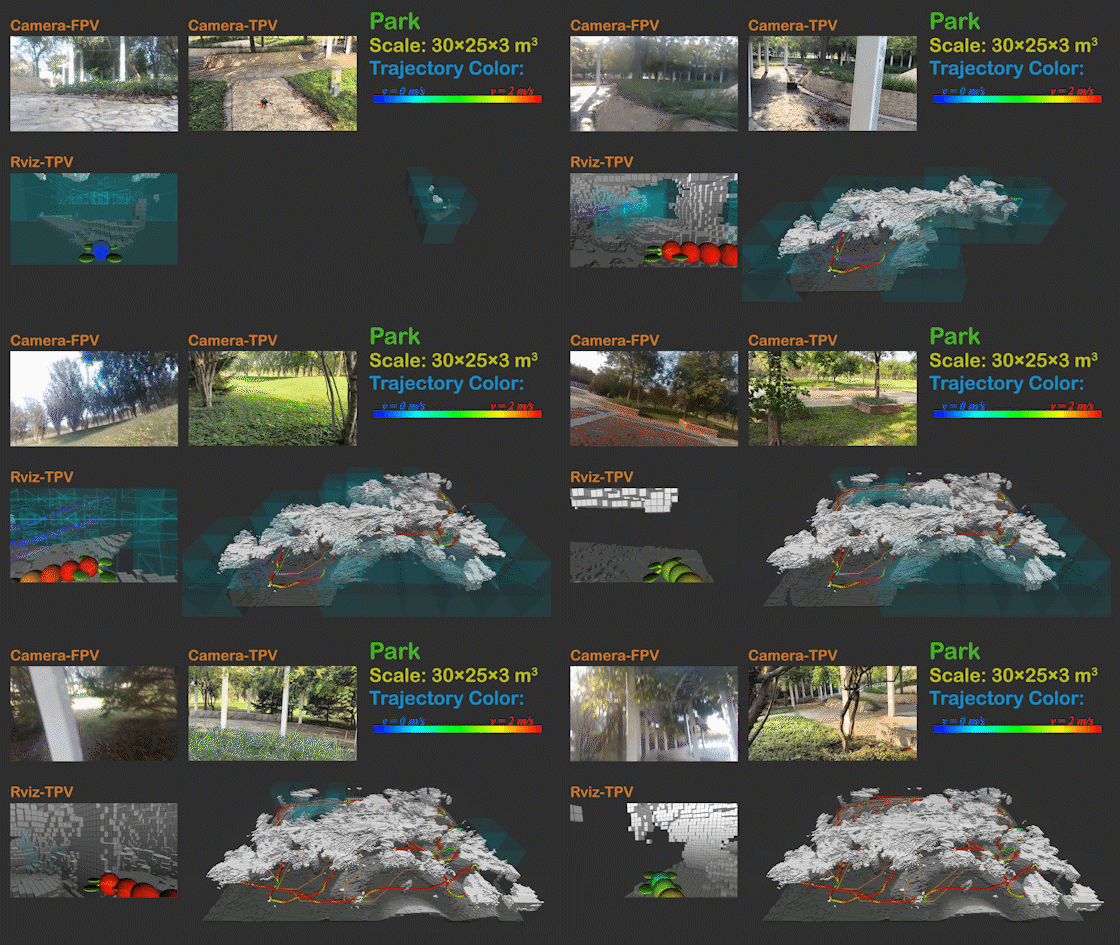
In this article, we propose an efficient dual-layer exploration planning method. The insight of our dual-layer planning method is efficiently finding an acceptable long-term region routing and greedily exploring the target in the first region of routing at high speed. Specifically, we propose a long-term region routing approximate algorithm, called “exploration-oriented heuristic double-tree algorithm”, to ensure real-time planning in large-scale environments. Then, the viewpoint in the first routing region with the highest curvature-penalized score, which can effectively reduce decelerations caused by sharp turn motions, will be chosen as the next exploration target. To further speed up the exploration, we propose an aggressive and safe exploration-oriented trajectory planning approach to enhance exploration continuity and speed. The proposed method is compared with state-of-the-art methods in challenging simulation environments.
EDEN: Efficient Dual-Layer Exploration Planning for Fast UAV Autonomous Exploration in Large 3-D Environments
[Code] [ieee] [arxiv] [bilibili] [youtube]
Qianli Dong, Xuebo Zhang, Shiyong Zhang, Ziyu Wang, Zhe Ma, Haobo Xi
IEEE Transactions on Industrial Electronics (T-IE) 2026
In this article, we propose an efficient dual-layer exploration planning method. The insight of our dual-layer planning method is efficiently finding an acceptable long-term region routing and greedily exploring the target in the first region of routing at high speed. Specifically, we propose a long-term region routing approximate algorithm, called “exploration-oriented heuristic double-tree algorithm”, to ensure real-time planning in large-scale environments. Then, the viewpoint in the first routing region with the highest curvature-penalized score, which can effectively reduce decelerations caused by sharp turn motions, will be chosen as the next exploration target. To further speed up the exploration, we propose an aggressive and safe exploration-oriented trajectory planning approach to enhance exploration continuity and speed. The proposed method is compared with state-of-the-art methods in challenging simulation environments.
HIGHSTAR: High-Speed and Efficient Online Autonomous UAV Exploration
Qianli Dong, Xuebo Zhang, Shiyong Zhang, Ziyu Wang, Zhe Ma, Tianyi Li, Haobo Xi
IEEE Transactions on Automation Science and Engineering (T-ASE) 2025
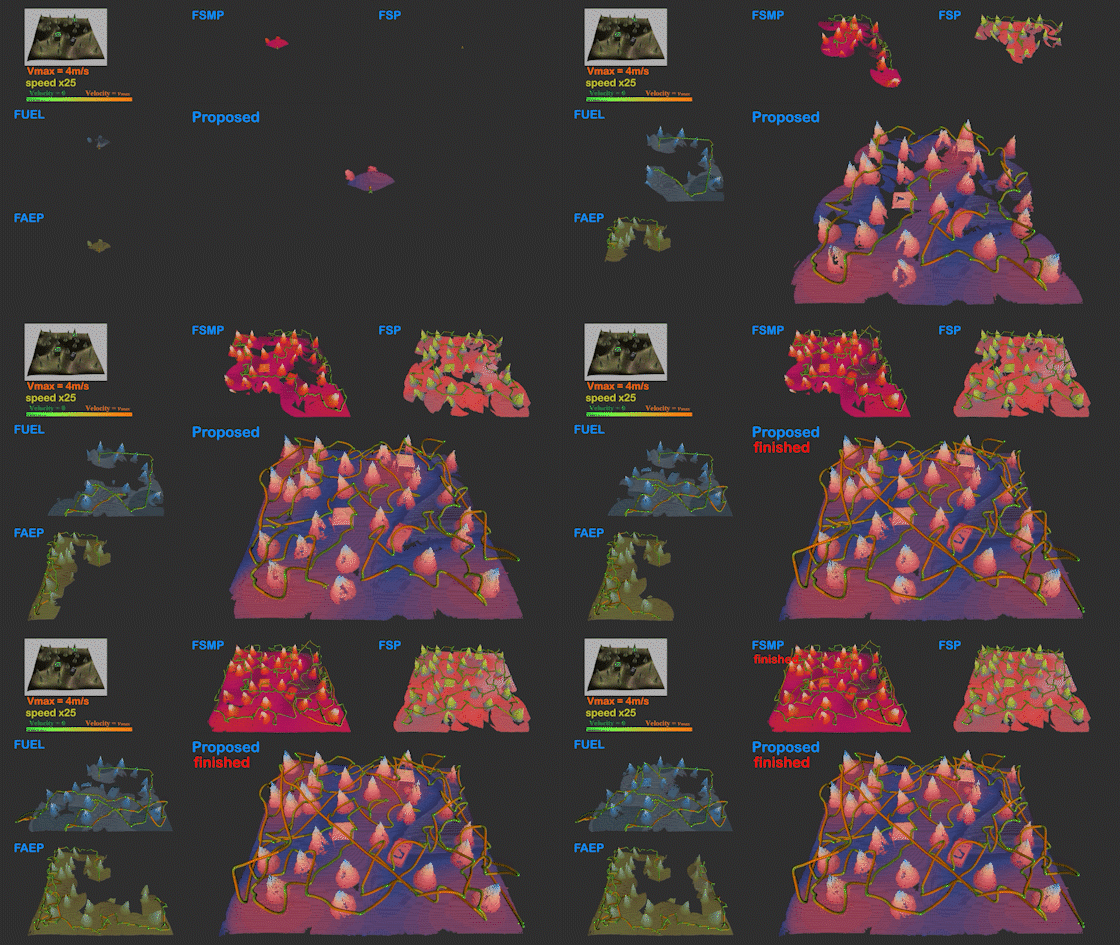
This paper presents a consistent, high-speed, and efficient online autonomous UAV exploration method. First, a motion primitive activated graph search method is proposed to fully take advantage of the UAV’s current velocity and acceleration. It improves motion time cost evaluation by simulating short-term motion tendencies with motion primitives and reduces the computational cost by searching on a voxel graph with a dynamic upper bound. Then, a minimum time trajectory to the optimal viewpoint with a non-zero terminal velocity constraint in a convex hull is optimized. Finally, an SE(3) coverage trajectory for unknown space around the exploration path is further optimized.
HIGHSTAR: High-Speed and Efficient Online Autonomous UAV Exploration
Qianli Dong, Xuebo Zhang, Shiyong Zhang, Ziyu Wang, Zhe Ma, Tianyi Li, Haobo Xi
IEEE Transactions on Automation Science and Engineering (T-ASE) 2025
This paper presents a consistent, high-speed, and efficient online autonomous UAV exploration method. First, a motion primitive activated graph search method is proposed to fully take advantage of the UAV’s current velocity and acceleration. It improves motion time cost evaluation by simulating short-term motion tendencies with motion primitives and reduces the computational cost by searching on a voxel graph with a dynamic upper bound. Then, a minimum time trajectory to the optimal viewpoint with a non-zero terminal velocity constraint in a convex hull is optimized. Finally, an SE(3) coverage trajectory for unknown space around the exploration path is further optimized.
Fast and Communication-Efficient Multi-UAV Exploration Via Voronoi Partition on Dynamic Topological Graph
[Code] [ieee] [arxiv] [bilibili] [youtube]
Qianli Dong*, Haobo Xi*, Shiyong Zhang, Qingchen Bi, Tianyi Li, Ziyu Wang, Xuebo Zhang (* equal contribution)
IEEE/RSJ International Conference on Intelligent Robots and Systems (IROS) 2024
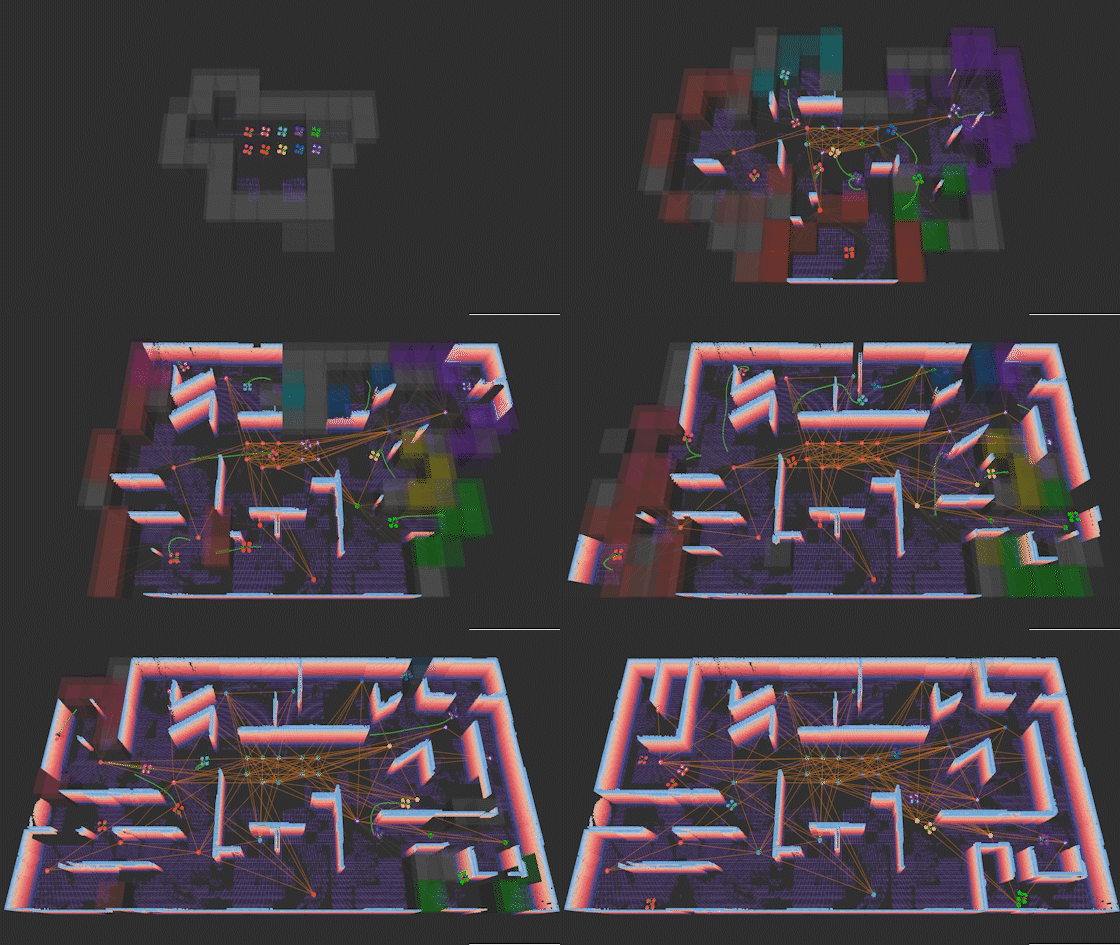
In this paper, we propose a fast and communication-efficient multi-UAV exploration method for exploring large environments. We first design a multi-robot dynamic topological graph (MR-DTG) consisting of nodes representing the explored and exploring regions and edges connecting nodes. Supported by MR-DTG, our method achieves efficient communication by only transferring the necessary information required by exploration planning. To further improve the exploration efficiency, a hierarchical multi-UAV exploration method is devised using MR-DTG. Specifically, the graph Voronoi partition is used to allocate MR-DTG’s nodes to the closest UAVs, considering the actual motion cost, thus achieving reasonable task allocation. To our knowledge, this is the first work to address multi-UAV exploration using graph Voronoi partition. The proposed method is compared with a state-of-the-art method in simulations. The results show that the proposed method is able to reduce the exploration time and communication volume by up to 38.3% and 95.5%, respectively. Finally, the effectiveness of our method is validated in the real-world experiment with 6 UAVs.
Fast and Communication-Efficient Multi-UAV Exploration Via Voronoi Partition on Dynamic Topological Graph
[Code] [ieee] [arxiv] [bilibili] [youtube]
Qianli Dong*, Haobo Xi*, Shiyong Zhang, Qingchen Bi, Tianyi Li, Ziyu Wang, Xuebo Zhang (* equal contribution)
IEEE/RSJ International Conference on Intelligent Robots and Systems (IROS) 2024
In this paper, we propose a fast and communication-efficient multi-UAV exploration method for exploring large environments. We first design a multi-robot dynamic topological graph (MR-DTG) consisting of nodes representing the explored and exploring regions and edges connecting nodes. Supported by MR-DTG, our method achieves efficient communication by only transferring the necessary information required by exploration planning. To further improve the exploration efficiency, a hierarchical multi-UAV exploration method is devised using MR-DTG. Specifically, the graph Voronoi partition is used to allocate MR-DTG’s nodes to the closest UAVs, considering the actual motion cost, thus achieving reasonable task allocation. To our knowledge, this is the first work to address multi-UAV exploration using graph Voronoi partition. The proposed method is compared with a state-of-the-art method in simulations. The results show that the proposed method is able to reduce the exploration time and communication volume by up to 38.3% and 95.5%, respectively. Finally, the effectiveness of our method is validated in the real-world experiment with 6 UAVs.